Tuesday, August 9, 2022

As Foggy as a Summer Day in Daly City

I awoke to the sound of the foghorn early this morning.  At sunrise, the island was covered in thick fog which ebbed and flowed throughout the day.  (The title of today's blog post is a tip of the hat to my sister in Daly City, California where the community's semiofficial motto is "If it's summer, bring a sweater". ) Fog makes seawatching impossible, but also makes quick work of solar panel cleaning. You only need a mop and brush for the most egregious gull artwork as all of the other panels are already sufficiently wet. I had the panels cleaned and windows washed on the researcher residence all by 7:30.  My weather report to Pedder Bay Marina lacked any information on the sea state, though, as I couldn't see the sea! I also had to run the generator, as the battery levels drop overnight, and without sun to boost them in the morning, they could get desperately low.


At 8 am and pm, I have to send a check-in message via a SPOT locator.  It doesn't work great inside the house, so I normally put it on the railing of the back deck.  There was an incident today. It seemed inevitable, really. I was not expecting this reaction from the device, though.

"An issue has been detected..."


I also washed outside of the windows on two of the sheds today. Check out my supervisor in the reflection. (Yes, I can see the inside of the windows need some work, too!)

Bubbles lounging right behind me


Today was a good day to launch my major project: rejuvenation of the compost bins.  I noted last year that one of the 4x4 ft bins has "matured" to the state that a good layer of grass was growing out of it.  This year, the vegetation was even taller. My goal is to empty one side completely and then move the contents of the other side over, adding much needed aeration and turning. I made a good start today by clearing the grass layer and moving 15 buckets of compost into one of the dips in the ground.

Before


Another supervisor

Plastic fruit stickers don't compost

Progress

First bucket of compost into the depression. 

Apparent approval by this gull chick


As usual in the afternoon, there were almost as many Black Turnstones as stones. I counted 174 in the east bay.

Black Turnstones with a smattering of Surfbirds


With the island blanketed in fog much of the day, there wasn't much scoping going on, so my attention turned more to the gulls. I made a rough map of the ones I could see from the front window today and will be interested to see if they are all in their same places tomorrow. Many of the young are starting to test out their wings against the fairly strong winds we had today as well. Today's gallery is mostly of  Glaucous-winged Gull antics.

Baby gull butts. They tuck right into the vegetation along the paths.

A bonded pair of Glaucous-winged Gull maintaining the bond by doing courtship displays.

Some appear to be considering renesting, but I think it's all for show.

Flight school


Mushu update: Turns out he loves being under the comforter.  He spent much of the day tucked in today.


Okay, I see you have your dinner.  Where are my treats?

And I'll leave you with a few random shots.  Census is tomorrow.  Hope I can see to count everything!

Elephant Seals

Pelagic Cormorants


California Sea Lions


Wasted opportunity!

Monday, August 8, 2022

And Then There Was One

 Last year, when I did my first stint as a relief ecoguardian, I spent my time on the island alone, except for a couple of maintenance visits from Greg.  This year, there were three of us for the first five days.  Abi and Jeremias (a Pearson College alum) were on the island as volunteers and to be honest, did most of the daily chores that I would normally be doing.  They stayed in the researcher/student residence, so our paths didn't overlap a lot, but it was nice having conversations with them about what was going on with the wildlife and infrastructure on the island. Monday morning, they packed (almost) everything up, and headed back to the big island with Greg. 

Jeremias and Abi bring all their belongings to the dock for departure.

Well, almost all their belongings.  I found these long after they left.


While they were at Race Rocks for the week, they had noted that the gull aggressiveness had lessened considerably. However, they still almost always wore their hard hats and sometimes carried a big stick to wave around over their heads to keep the agitated gulls at bay. The gulls have a two-pronged approach in their attacks from the rear: 1: spray you with excrement 2: smack you in the head. Abi and I had both been on the receiving end of approach 1 over the weekend, but none of the gulls had tried approach 2 on me with any seriousness--until yesterday.  Almost as soon as they left, a gull came up behind me and knocked the glasses from the top of my head into a rocky crevice along the shore. I am definitely much outnumbered now!  I wonder if they go for the tallest person on the island.  Despite my lack of height, that is me as of today.


Birdviewing from the solar panel roof is pretty awesome, but really only in the early mornings.  I managed a few new species for my trip list yesterday with a distant Parasitic Jaeger, and a much closer Common Loon.  There were lots of drifting logs, all carefully searched for anything Booby-like, but the best I could come up with was a Short-billed (formerly Mew) Gull.  Harbour Porpoises were active again in the tide lines.

All birds on logs got close scrutiny through the scope--better resolution than the camera.

This apparent two-finned mammal confused me until I realized it was a young one alongside the adult.

The dots on this one are still confusing me

One of the challenges (and I know my friends will be shocked to read this) of combining the work with the pleasure is ensuring that I have all my gadgets on board. In the morning, I must take the VHF radio, and depending on the time, the SPOT locater for my check-in. Add binoculars, scope, tripod, camera, cell phone, FRS radio so I can call friends at Rocky Point, backup batteries, and cleaning tools (buckets, brushes, squeegee, etc.) and it's more than an armful. I need a sherpa!

Once the heat shimmer hits, though, seawatching is much more difficult. It's not too bad close in, but at any distance, the tiny specks turn into tiny, blurry specks beyond my identification confidence level. 

I felt a bit like a mad scientist gearing up to top up the solar panel batteries in the afternoon. There are 24 large batteries that need to have their water levels checked and corrected each week.  Protective gear is required from head to foot in case of sulphuric acid spashes.


I find the Pigeon Guillemots fascinating, and could spend hours just trying to get beautiful photos of them. Prepare yourself for more PIGU photos than you can stand.


Poop happens!


Life goes on off the island as well, and thanks to good internet service, I'm still a big part of that.  While lining up speakers for the Victoria Natural History Society Birders' Nights yesterday, I finally saw two Brown Pelicans fly low over Great Race before disappearing behind the researchers' residence.  Sadly, I could not relocate them, but I suspect they were on the rocks right near the water.

Mushu in a spot of sunshine by the backdoor.  His servant brought something soft for him to sit on.


Some have suggested that Mushu should have his own blog.  I am saying "no" to that, but I will provide a sample of what a Mushu blog would look like:

Woke up after a good night's sleep.  Mom left.  I went back to sleep.  Mom came back and woke me up.  I went back to sleep. Woke up to pee.  Ate some food and went back to sleep. Mom must have gone out because she just came back and woke me up again.  I walked into the kitchen and then back into the bedroom to take a nap. Woke up and went into the living room.  Settled down into one of the chairs and went to sleep.  Mom is working on the computer so I must go stand in front of the screen.  Mission accomplished!  Now I can go back to sleep. 

Repeat, repeat, repeat.  Anyway, Mushu definitely seems comfortable and I am sure is happy to get as many wakeups as he is. And I'm happy to have him here!

And last shot for the day.  The water is so clear, you don't need to be underwater to do underwater photography.

Young harbour seal alongside the jetty.


Sunday, August 7, 2022

All in the Family

The day started with what was going to be another seawatch, but distractions got in the way. My first look through my scope landed on a small group of Orcas in the distance.  Despite my attempts to alert the volunteers, it was sadly another miss! Those were the only whales I saw today, and the whalewatching boat numbers were way down from Saturday, despite great flat-water conditions.  I can only guess that there were whales closer to town today, keeping the boat traffic down. There were several passerined that passed over today, frustrating fast and when I had my hands full, so no identifications.

I did see something unusual from my perch near the solar panels.  Can you identify it?

What is that behind the murres?


A close-up


Yup, a mylar balloon. Balloons blow, and are just another piece of trash that frequently ends up in the ocean. A lot of our environmental transgressions start out without bad intentions, but in the end, it isn't the intentions that matter.  I shudder to think of the millions of scraps of plastic, mylar, and string we have sent into the environment for human celebrations. Thankfully, this is another tradition that is winding down due to concern for nature. 

Puzzle pieces started to fit together about the log boom I saw a couple of days ago.  During the Sooke Christmas Bird Count, my area includes the William Head Institute.  I recall now seeing piles of logs at one end of their parking lot. They operate a small sawmill there, I suspect as a training opportunity for soon-to-be released inmates. The tugs were definitely headed in that direction!

One of the attractions of a barely inhabited island is that it is a great place to raise a family. In a place like Race Rocks, the species diversity of breeders, at least above water, is quite limited, but the numbers can be quite high.  Last year when I was here, I counted about 800 Glaucous-winged Gulls.  This year, there are about half that, and reports from others indicate that survival of chicks was not good. That said, the parents are fierce defenders, and do their best.  While it's difficult to say what is the issue this year, I hear reports of similar failures on other islands.  I watched one gull feed a piece of fish to one of its chicks, then grab a mouthful of dirt and grass for the other two.  Despite the action on the ocean, is it possible that gulls are having a hard time finding food this year?

Glaucous-winged Gull chicks at sunset


Another species of bird that breeds here is the Pigeon Guillemot.  While it doesn't look like everyone in the group is breeding, I've found two likely nest locations. The parents are quite secretive about it when humans are around, and won't enter the spot if they think you are watching.  But still, I've found two so far.  I can't help but thinking that any number of gulls have also been watching these parents bringing in food and are just waiting for the opportunity to grab the young chicks when they make an appearance.


Black Oystercatchers also breed here. While this population is considered stable, the estimate is that there are only about 15,000 in the world.  Gulls have been observed preying upon them here, too. It seems a longshot to have offspring survive in a gull colony. 

Black Oystercatchers

Black Turnstones don't breed here, but come shortly after leaving their breeding grounds in western Alaska. Once here, they start to molt their feathers. You can see some new primaries (wing feathers) coming in to replace the old ones in the photo below. Many turnstones will remain in our area over the winter, but others will continue south as far as Baja California.


Molting Black Turnstone (special treat for my bird banding colleagues)

Of course, mammals also breed on Race Rocks.  Harbour seals proliferate, much to the chagrin of many fishermen. There are dozens of adults and pups around the edge of Great Race and on the smaller islands.  

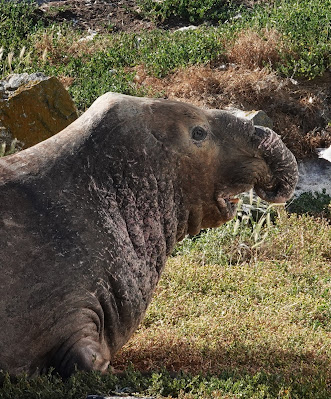
In recent years, northern elephant seals have started pupping here as well, but the survival rate has been low. Most common cause of death has been being crushed by the male in his attempts to mate with the females.  He's not about to let a pup get in the way!  This year, though, the survival has been good, with a few pups still hanging out around the island.  One (presumed female) has been following Bubbles around, but he's not a real family guy.  Today, while two young elephant seals were on the jetty ramp, Jeremias took a bit of a swim off the dock.  While Abi and I were keeping an eye on nearby marine mammals, the alpha elephant seal came around the corner and swam right below him.  (It was a little scary, but looked REALLY cool! Bubbles didn't take much notice of Jeremias, who very quickly got out of the water, but was not happy about the pups blocking his way.



Mushu is settling in and actually got up the nerve to look out the window today. What a culture shock from living in the middle of a forest! He wasn't keen on human visitors, though, and went back under the bed. He also discovered he could work his way under the comforter on the bed to be both comfy and hidden.


The volunteers leave tomorrow and I will be on my own for a while. I'm starting to settle in to a rhythm of my own, but I have a project or two up my sleeve.


Here are some more photos from today:
Great Blue Heron

Bubbles suggesting the pups get out of the way

Surfbird

Sunset looking south

Discovery Princess departing at sunset

Sunset looking southwest