Saturday, August 6, 2022

All's Calm

 Saturday, Aug 6

You couldn't have asked for a nicer day today. Clear skies, calm water all day, moderate temperature--at least here in the middle of the ocean. The day started with a paired seawatch:Daniel Donnecke at Beechy Head and me on Race Rocks.  There was a fair amount of movement and we even managed to match up a particular flock of Common Murres which appeared to take only two minutes to make the distance. It was unique in that it was headed up by a Rhinoceros Auklet, although by the time it got to me, it had picked up four more murres.

Seawatch involves identifying and counting tiny specks as they speed past at great distance. These are Common Murres.


Being the weekend, there were many, many boats on the water, including the Second Nature from Pearson College bringing homecoming students around for a reunion tour. While most boaters behave themselves in the ecological reserve, there were a number today that didn't follow the rules.  I even got to use the loudhailer to get one of them to slow down!

Pearson College Reunion Tour


Solar panel cleaning reached a new level this morning when, in addition to the usual deposits, I found that a gull had regurgitated a bellyful of sea stars. I've often wondered why they eat these spiny echinoderms.  I guess one gull was asking itself the same question.

Work to do!


Sunday brunch

There is so much going on around the island that I forgot to mention one of my most unusual sightings yesterday. Growing up in Victoria, this was a common occurence, but it's been decades since I've seen tugboats guiding log booms into local waters.  With no mills here, I have no idea where they were headed or why.

Tugs taking logs into Victoria


Both humpback whales and Orca were seen off Race Rocks today.  The easiest way to spot them is to watch for the "parked" whale watching boats.  If the boats are going fast, no whales. If they are stopped, watch for the blow!

Two of three Orca in this group


The most unusual bird sighting for the day was a Short-billed Dowitcher on the East Beach, and I finally got an opportunity to get a photo of the Ruddy Turnstone that has been wandering all over the island.

Short-billed Dowitcher

Short-billed Dowitcher

Ruddy Turnstone


Mushu update: Mushu is making himself at home.  He still doesn't like looking out the window, but I think he's gotten use to the sights and sounds.  It appears that home is where the lap is.


No real adventures or spectacles today. Just more jaw-dropping beauty!

Bubbles helping with seawatch

Pigeon Guillemot

Pigeon Guillemot.  I may have to do a gallery just on the variety of fish they catch.

Glaucous-winged Gull chicks

Two young elephant seals just chillin'


Friday, August 5, 2022

The Pelican Jinx

Friday, August 5
Since I have been getting up very early for a couple of weeks, I figured I could start attempting a morning seawatch around 6 am. After all, that's three hours later than my alarms have been set, and I can literally walk to the seawatch spot in about 90 seconds. I made it almost on time, with a cup of tea in hand. The numbers of birds were not high, but the expected Pigeon Guillemots, Black Turnstones, Common Murres, Rhinoceros Auklets, California and Glaucous-winged Gulls were all present and accounted for. I was very happy with myself for identifying a distant Red-necked Grebe in flight. But before the hour was out, the fog was in. I retreated to the ecoguardian's residence for some breakfast, before heading to the solar panels to get to work. This is my strategy this year: intersperse birding and chores. Last year, I missed much of the good birding time by trying to get the work out of the way. I have a better sense of how to combine both this year. As the fog rolled in, a passerine flew quickly past me. It was dark and medium-sized, but that was all I got of it. Frustrating, as there are so few seen here. 

The solar panels were easy to clean today. A combination of the fog making the surfaces wet, and a new cleaning tool(repurposed snow brush/squeegee/scraper combo) I brought with me made the work go much more quickly than trying to switch tools for each task. From that viewpoint, I was also able to see a Ruddy Turnstone below, but sadly, no photos. The highlight was a "fogbow" that appeared as the fog started to lift. 


Mushu is settling right in. He does not like to look out the window--too many loud, flappy things and blue sloshy surfaces out there! I suspect he'll become accustomed to them before it's time to leave, but for now, he's happy sleeping and exploring the house. He even found a bit of sunshine today. And he got to be in a TV interview! Even here, there are still ways to communicate with the media, and the levying of fines for free-roaming cats is newsworthy at the moment. 


Later in the morning, I met up with Jeremias and Abi to test and repair the electric fencing that keeps the California Sea Lions from the are immediately around the houses. Okay, friends. I am here until at least August 25. On what date do you think I will first feel the impact of the fence? I am going to try to get off the island shock-free, but it feels almost inevitable. Even with the fencing, a determined marine mammal can still get pretty much wherever it wants, as evidenced by this young elephant seal. 


Perhaps the best sighting of the day was a flock of about 15 Barn Swallows migrating across the strait.  This is what I'm watching for!
Southbound Barn Swallow


I'm still playing catch-up on missed sleep (as I write this after midnight, I'm apparently not making many gains in this regard), so I thought I would have a short afternoon nap. I guess I took two. During my time "away", Abi and Jeremias saw at least 10 Brown Pelicans. My only consolation is that I wouldn't have been able to see them from my location even if I had been awake. 

 A trip up the lighthouse this evening produced one interesting spectacle. Two sea lions were catching fish just off the jetty, bringing dozens of gulls to join them in hopes of a few scraps. Check out these photos of one literally standing in the sea lion's mouth! I guess this explains how some gulls lose their feet.
There are always bits and pieces to be found
I wouldn't try this.
Right in the mouth!!
One managed to snag the head of a fish and returned to its mate with it.

Daniel Donnecke is planning a seawatch from Beechey Head on Saturday morning, and I will do a corresponding one here. We'll see how things compare!

More photos from today:
Breakfast!

Loads of guillemots!


Sea lions galore!

More flies than birds, but great protein for everyone

Whale watchers watching a humpback whale

Northern (Steller's Sea Lion)

Mixed cormorants

Dinner

Female Harlequin Duck (often mistaken for Bufflehead this time of year)

Bull in a china shop (Canada Goose plowing through Black Turnstones)


Thursday, August 4, 2022

Race Rocks Redux

The ecoguardian residence and lighthouse tower at Race Rocks

It's been almost a year, but I am back at Race Rocks, serving as a relief ecoguardian for three weeks this time.  For the first time in two weeks, I didn't have to get up around 3 am for a shift at Rocky Point Observatory, so guess what time I woke up? Yes, 3 am, because although I changed one of my alarms to 6, I neglected to reset the other two. Sheesh! I went right back to sleep though and got up at 6 for a semi-frantic "finish packing and try not to forget anything important" morning. The biggest complication was that this time I was packing for two.

Meet Mushu, my 17 year old companion, a life-long indoor cat near the end of that life.  I had honestly not expected him to still be with us when I accepted the offer to return to Race Rocks last January. I had been pretty stressed about the idea of leaving him behind feeling that I had abandoned him, so I took a chance and asked permission for him to come with me.  Because he is an indoor cat, I was granted permission. So, late in life, Mushu gets a big adventure. It's his first trip away from home.

Mushu chilling on the boat


Mushu has been sleeping in his travel crate all week, but when I put him in the car in it, I think he felt a bit betrayed.  He did not enjoy the ride, despite being a champ on test car rides in the last couple of weeks. He ended up on my lap for most of the trip to Pearson College to board the Second Nature for the trip to Race Rocks.  I was most concerned about the boat ride.  What would a homebody cat think of that?  Well, I needn't have worried.  Back in his crate aboard the boat, he settled right down and was calm for the whole ride. Captain Greg Dickinson and fellow passenger Garry Fletcher's presence seem to reassure him, despite a splashy ride over in a bit of wind.

We were greeted at the dock by departing ecoguardian Nick Townley, and visiting volunteers, Jeremias Prassl and Abi Adams-Prassl, who helped get my mountain of stuff up to the house. Once I set Mushu up in one of the bedrooms, we all spent a bit of time looking around the island and getting me up to speed on my list of daily tasks and chores. It will be great to have help for a few days until they leave next week. 


Black Oystercatcher

First order of business for me, though, and for Mushu, was a much needed nap.  I have been burning the candle at both ends for a couple of weeks with the startup of migration monitoring at Rocky Point Bird Observatory, just across the water from Race Rocks, and next door neighbour to Pearson College. Then it was time to check out the bird and other wildlife.

Race Rocks is home to a significant Glaucous-winged Gull colony, forcing the humans on the island to resort to wearing hard hats in recent weeks. I would estimate the numbers to be half to two-thirds what they were this time last year. I understand that a lot of the nests failed this year, and that is definitely in evidence, despite there still being plenty of chicks and their very defensive parents.

Glaucous-winged Gull with chicks

Other gulls seen today include a good group of California Gulls, and a few Heermann's Gulls. While we were greeted by dozen's of Pigeon Guillemots when we landed, they had almost all vanished by early evening. The east beach housed about 200 Black Turnstones and a dozen Surfbirds. As happened last year, Killdeer show up only after dark.

Triplet Glaucous-winged Gull

The big male elephant seal ("Bernard" to many, but "Bubbles" to me) is back and hanging out near the student/researcher building.  There are also at least a couple smaller elephant seals here this year.

Young elephant seal
Bernard/Bubbles

Mushu has made himself more or less at home and is curled up in a chair near the woodstove as I type this. Tomorrow starts my work here in earnest. Let's see what the strong west wind blows in tonight!

Saturday, September 4, 2021

All the Birds (and the end of the adventure)

When I knew that I would be spending a week at Race Rocks, one of the first things I did was draw up a wishlist of birds I might see from the island. By the end of the week, it served as the list of birds I didn't see. One of the big attractions of these offshore islands is that hungry or tired birds might stop by for a bit of rest and refueling.  Race Rocks has turned up several impressive birds over the years, although most have been noted in the winter.  I was excited to see what might land while I was there. I now realize that an exhausted small bird would probably end up in the belly of a gull during nesting season!

Brown Pelican was near the top of my list, and I may have seen one my first night, but it was so far away, I wasn't confident enough to include it on my list. Other no-shows included any jaegers, any phalaropes, and any shearwaters. Since my return to civilization, they have all turned up within eyeshot of the island!  I guess I was just a couple of weeks too early. 

Other than the gulls mentioned in the first blog about this adventure, Pigeon Guillemots were the most numerous birds at Race Rocks, some days numbering well above 100. They were all in breeding plumage, with no young.  I know they nest on the island, but am quite curious about the lack of chicks. I suspect that most are lost to hungry gulls, although I did see a few sneaking fish into crevices. There may have been a few still in the nest. Besides their cute look, bright red feet and mouths, they have a very appealing "spaceship" or "laser beam" whistle that could be heard almost as constantly as the gull chatter. There were a few Double-crested and Pelagic Cormorants, mostly on the north side of the island.  I suspect they will be there in much higher numbers soon as they return from their breeding sites.


Pigeon Gullemot


At great distance, Rhinoceros Auklet, Common Murre, and one Cassin's Auklet put in appearances. None of these would have been noticed without binoculars or identified (at least by me) without a scope. On three occasions, Daniel Donnecke and I compared seawatch notes for an hour starting at dawn. Daniel was a few kilometers away at Beechey Head, but I didn't see any of the groups that he was noticing moving east during that period.  Of course, there's a good chance that he was seeing birds several km out in the channel, and by the time they passed Race Rocks, they would have been farther still. The only likely duplicate was a significant group of several hundred California Gulls that left Race Rocks heading west that showed up at Beechey Head a short time later.

Distant Rhinoceros Auklet


There were a few shorebirds as well: Black Turnstone, Black Oystercatcher (one very young), Least Sandpiper, and Western Sandpiper. There is a tiny, pebbled bay on the east side of Great Race that draws most of them, although the area of the dock is fairly popular with the shorebirds, as well. Killdeer could also be heard on the island, although only at night.  A couple seemed to arrive around 9:30 pm but were gone by first light.

Black Oystercatcher with young

Black Turnstone

Least and Western Sandpiper


I was honestly surprised at how few "landbirds" made their presence known during my stay. There are not a lot of hiding spots on the island, especially if you rule out gull territories. Here's the entire list:

1 Anna's Hummingbird (heading north)

1-3 Brown-headed Cowbirds (seen three times, but could have been the same individual)

Brown-headed Cowbird


1 Feral (Rock) Pigeon

1 Song Sparrow (same bird hiding out in a wood pile away from the gulls for several days)

Song Sparrow


1 Bald Eagle (on the rocks between Great Race and Bentinck Island)

22 Purple Martins (made 1 loop around the lighthouse and headed south)

And the bird of the week: 1 Yellow-headed Blackbird!

On my last morning, as I was doing the chores, I rounded the corner back to the house and there, on the ground, was a non-gull bird!! I immediately recognized it as a blackbird, but the colours were not what I expected. The head and breast were buffy in contrast to the darker body and wing feathers.  There was also a white patch on the belly. I was pretty sure it was a Yellow-headed Blackbird, albeit a bit odd looking. Where was my camera? In the generator building, of course, where I put it while washing the solar panels. I took a couple of really bad shots with my cell phone, and retreated to get my camera.  Of course, when I got back, no blackbird. After searching around a bit without any luck, I climbed the lighthouse for a view of the whole island.  I could pick out Black Turnstones, so I thought I should be able to see a blackbird, too.  No luck. Resigned to just having my cell photos, I returned to the house to pack up for my trip back to Victoria.  Then, while I was on the phone about an hour later, I looked outside, and there he was! The call was ended, and I spent far too long and FAR too many pixels documenting this bird. The strange colour was starting to bug me, though.  Could this just be another Brown-headed Cowbird?  Occasionally, pale-headed varieties are seen.  I'd already put the word out about the blackbird. Would I be eating crow about the ID? However, zooming in on one of the photos, I could clearly make out a few bright yellow feathers.  Whew!  It turns out this was a young blackbird, just going through the molt that will make him easily recognizable as a Yellow-headed.

Yellow-headed Blackbird


That little episode cut into my cleaning and packing plans, and I barely had things wrapped up when Greg and Jeff showed up at the dock to take me back to Pearson College. Greg took over as the island's resident for the weekend, something he had not yet had the opportunity to do, while Jeff whisked me back to my regular life. 

Living on a small island for a week made me think about things I often don't. In my case, these included:

  • my own biological waste (the surprising volume and having to deal with it), 
  • how much we take a reliable energy supply for granted (and how much we use!), 
  • the amount of large ship traffic through the strait (easily more than 10 times as much as I would have thought),

Massive load of logs
  • how almost devoid of natural vegetation and covered in introduced grasses and plants these small offshore island are (and how impossible that might be to change when gulls and wind would constantly be reintroducing seeds from adjacent lands)
  • how much foreign material/chemicals we introduce into the ocean every day

There was a sign above a sink that reminded residents that the drains went directly into the ocean. If I'd been asked to go empty a bottle of dish-washing soap into one of the bays, there is no way that I would do it, but every day, most of us do it little by little, often without a thought. Same with our detergents and microfibers from our laundry, the oils and grease we wash into our drains, and heaven forbid, the paints, caustic cleaners, and who knows what else! Our treatment plants aren't going to have much of an effect on many of these substances.

What have we put into that fish?

In the 1970s, a saying I often heard was "The solution to pollution is dilution."  It made sense to me then. But now I wonder at what point does the saturation level become toxic to life in the sea? It seems to me that we are already past that point. I don't know how we can change our course, but I left Race Rocks thinking that this may be as important an issue as climate change, but not one at the top of our minds. 

The time passed very quickly, just about the point I was feeling like I was getting the hang of things. I hope I get a chance to be a relief Eco-guardian again to put what I've learned to use. Thanks, Pearson College, for the wonderful opportunity!
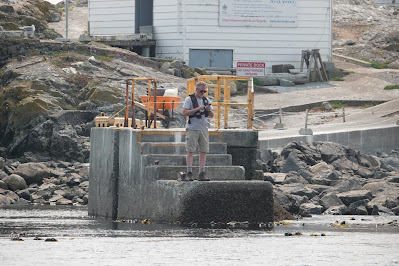
Pulling away from my adventure. Have fun, Greg!